
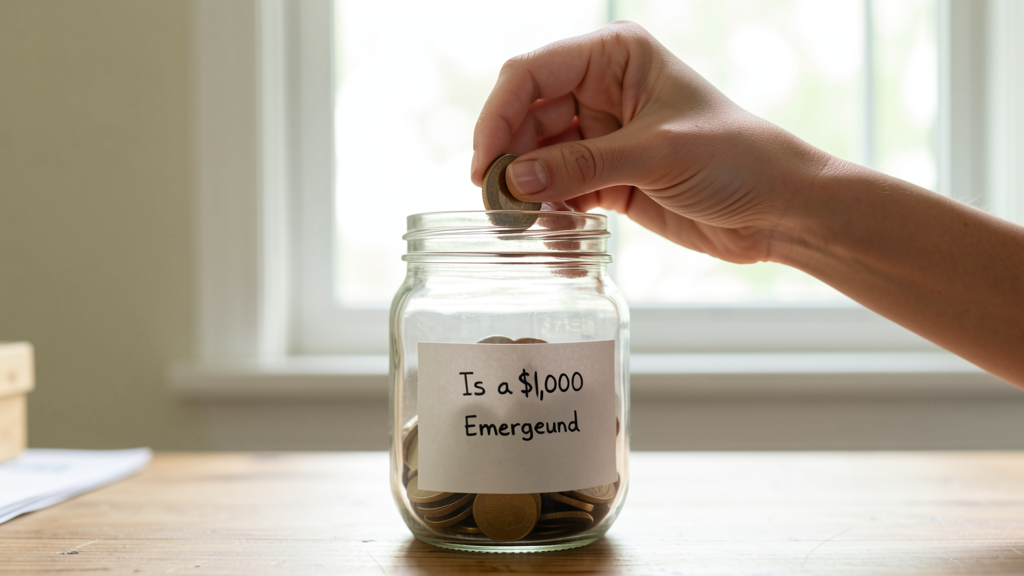
Is a $1,000 Emergency Fund Too Small to Start Investing?
We analyze the mathematical loss of hoarding cash versus the psychological safety of liquidity to determine if a $1,000 emergency fund is enough to trigger your investment strategy.


The tension between saving for a rainy day and building wealth for a sunny future is one of the oldest conflicts in personal finance. For years, conventional wisdom suggested stashing away three to six months of expenses before even thinking about buying a single share of stock. In 2026, however, with high-yield savings accounts offering decent returns and the stock market exhibiting its usual volatility, that advice feels increasingly stale for a generation eager to build wealth. The question isn't just about safety; it is about the cost of safety.
I recently spoke with a reader, let's call him Marcus, who had $5,000 saved up. He was agonizing over whether to dump the extra $4,000 into an index fund or keep it in cash. His fear was a sudden job loss or a car breakdown. His desire was to stop losing ground to inflation. This dilemma is mathematical and psychological. To understand if $1,000 is a sufficient buffer to start investing, we have to strip away the generic rules and look at the specific trade-offs you are making every day you leave money on the sidelines.
The False Sense of Security a Single Grand Provides
Let us be clear about what $1,000 actually covers in the current economy. According to 2026 cost of living adjustments, this amount might cover a minor car repair or a surprise medical bill, but it will not insulate you from a significant life event. If you lose your primary source of income, $1,000 vanishes in less than two weeks for most renters.
However, waiting until you have a fully funded emergency fund—often $15,000 or more—can delay investing by years. This delay carries a heavy price. When you prioritize liquidity above all else, you are not just saving money; you are spending the opportunity to earn compound interest. The "security" you feel is often illusory because you are insuring against a low-probability, high-impact event (total job loss) at the cost of a high-probability, certain impact (the erosion of purchasing power).
The danger of the "all-cash" strategy is that it treats the market as an enemy to be avoided rather than a mechanism to be utilized. By holding $10,000 in cash instead of $1,000, you are essentially paying an insurance premium. The premium is the difference between the return on your cash and the return on the market. If that premium becomes too high, you are over-insured, and your net worth suffers for it.
Why You Should Calculate the Opportunity Cost of Cash
We need to look at the numbers. As of May 2026, a competitive High-Yield Savings Account (HYSA) might offer you 4.0% APY. Meanwhile, the historical average return of a diversified stock market portfolio hovers around 8% to 10% before inflation. If we assume a conservative 7% return on a diversified portfolio to account for inflation, the gap between cash and equities is roughly 3%.
Imagine you have $9,000 above your $1,000 base. If you leave that in cash for a decade, you earn roughly $4,300 in interest at that 4% rate. If you invested it instead, assuming a 7% average annual return, that sum grows to roughly $17,700. That is a difference of over $13,000. By waiting to feel "safe" with a larger cash pile, you effectively paid $13,000 for peace of mind.
This calculation assumes you do not touch the money, which is rarely the case. Cash is liquid, and when it is available, we tend to find reasons to spend it. Investing, particularly in vehicles that require a bit more effort to liquidate, introduces friction. This friction is often an asset. It prevents impulsive spending on consumer goods that do not generate long-term value.
The decision becomes clearer when you evaluate specific investment vehicles. You must decide if you want to prioritize tax efficiency or simplicity. For instance, understanding the nuances between fund types can save you money in the long run, making that initial risk worth taking. When you start moving beyond cash, you realize that not all investments are created equal, and choosing the right structure is crucial for maximizing the gap between your cash return and market return.
Does Your Risk Tolerance Match Your Bank Balance?
The argument for a larger emergency fund rests entirely on your personal risk tolerance and income stability. If you are a freelancer with volatile income or work in a shrinking industry, $1,000 is reckless. You need cash flow insurance. But if you have a stable government job or a tenured position with strong benefits, your probability of a sudden, total income stoppage is low.
For those with stable income, the risk of investing with a small emergency fund is manageable. The worst-case scenario is a market downturn coinciding with a personal financial emergency. If the market drops 15% and your car breaks down requiring $2,500, you might have to sell your investments at a loss. This hurts. However, looking at historical data, the frequency of this perfect storm is lower than the certainty of inflation eating your cash holdings.
To mitigate this, you can employ a "barbell" strategy. Keep your $1,000 in cash for immediate liquidity. Put the next $3,000 to $5,000 into a safer investment, like a short-term bond fund or a money market account, which offers slightly higher yields than a savings account with relative stability. Only then begin allocating to volatile stocks. This creates tiers of safety rather than a binary switch between "saving" and "investing."
Furthermore, you can manage the timing risk. Instead of dumping a lump sum into the market, you can drip your money in. This method smooths out the purchase price over time, reducing the anxiety that you are buying at the peak. It turns the act of investing from a single, scary bet into a disciplined habit.
The 50/50 Split: A Compromise for 2026
If you are still paralyzed by the fear of draining your account, consider a mechanical compromise. For every dollar you save above your initial $1,000, split it. Invest 50% and keep 50% in cash until you reach a comfortable emergency fund threshold of, say, three months of expenses.
This approach builds your investing muscle immediately while acknowledging your need for security. It slows down the growth of your cash cushion slightly, but it gets you into the market years earlier than if you waited to fully fund the cash pile first. It also allows you to adjust your ratio as you become more comfortable with market fluctuations. You might start at 50/50, but after seeing your balance grow for six months, you might shift to 70/30 in favor of investing.
You must also consider the tax advantages of investing sooner. If your employer offers a match on a 401(k) or you are eligible for a Roth IRA, delaying contributions to build a cash fund is often a mathematical error. You are leaving free money on the table or losing valuable tax-advantaged space that you cannot get back. If your employer matches 4% of your salary, that is an immediate 100% return on your investment. No emergency fund yield can compete with that.
Finally, look at your recurring expenses. Can you lower your monthly burn rate? If you reduce your necessary expenses by $300 a month, your $1,000 emergency fund effectively lasts longer. This allows you to be more aggressive with your investing strategy because your "runway" is extended. Budgeting is not just about cutting costs; it is about buying freedom to take calculated risks with your capital.
Action Step
Call your bank or log into your mobile banking app today. Create a new automatic transfer rule. Set it to transfer 10% of your paycheck to a high-yield savings account until it hits $1,000, and simultaneously set a rule to transfer an additional 10% to a taxable brokerage account or IRA immediately after that threshold is met. Do not wait for a "perfect" time or a larger sum; start the split today.
The debate over the "right" amount to save before investing is a distraction from the primary goal: ownership. Whether you start with $50 or $500, the act of moving money from a savings account to an investment account changes your relationship with money. You stop being a passive saver and become an active owner of capital. While the experts will continue to argue about the perfect ratio of cash to equities, the market does not wait for you to feel ready. It rewards those who participate, even if imperfectly. A $1,000 emergency fund might feel small, but it is sufficient to cover the bumps while you start climbing the mountain. The true risk is not that you might have to sell a stock to fix a transmission; the true risk is that you reach retirement age with nothing but a pile of depreciated dollars and a list of reasons why you never started.
Read next

ETF vs. Mutual Fund: Which Wins for Taxable Accounts?
Unwanted capital gains distributions can silently destroy your taxable returns; here is why ETFs usually hold the upper hand over mutual funds for non-retirement money.

Dollar-Cost Averaging Works Best in Volatile Markets: Here's Why
Discover how volatility can become your greatest ally by lowering your average share price through disciplined, fixed-amount investing.